



search
date/time

Mon, 4:00AM
broken clouds
11.0°C
ENE 6mph
broken clouds
11.0°C
ENE 6mph
 | Sunrise | 3:37AM |
| Sunset | 8:45PM |  |
P.ublished 3rd August 2023
frontpage
71% Of Graduates In The North West Say Going To University Got Them The Job They Wanted

Megan Galuidi
Megan, who grew up in Moorsholm, East Cleveland, said: “Ever since I was young, I’ve been interested in the mechanical aspects and functions of vehicles, machinery and technical structures such as the Transporter Bridge. I was keen to understand the various components which enable models to move and function, and why they were necessary. I had originally pursued a career in an area deemed more 'gender appropriate', largely due to common ideologies of societal norms and gender role expectations. But following the birth of my son, I developed a higher consciousness of responsibility and a more mature mindset. This led me to decide to return to education to progress in a career that I would feel passionate about.
I chose Teesside University due to its reputation for engineering. This was in addition to the campus being local to me and accessible, which was necessary for me having a child and already being based in the area.”
“I really enjoyed the modules which involved hands-on experimental aspects. One example was the Grand Global Challenges to develop a small-scale wind turbine. This needed creativity, problem solving and teamwork, while also developing the skills and knowledge which could be applied to the workplace.”
“I applied to Worley after their representatives visited the University to give a presentation on their current projects and career opportunities. I saw it as a fantastic opportunity. Studying towards a degree requires hard work and perseverance, but with focus and determination, is something that can only lead to a positive outcome and is beneficial to your future. Obtaining my degree through Teesside has enabled me to begin a career in something that I feel passionate about.”
The research, based on the perspectives of 3,500 UK graduates and 3,500 business leaders (business owners, founders, board members, CEOs, directors and senior managers) across the UK, also reveals that 77% of graduates in the North West say going to university enabled them to build skills that have proved professionally valuable. And, for 74% graduates and 83% of business leaders in the North West, going to university helped to build their self-confidence.
Just under two thirds of graduates (65%) and three quarters of business leaders (75%) in the North West also believe that going to university enables graduates to build vital transferable skills that help them in their career; framing UK universities as an essential training ground for UK industry.
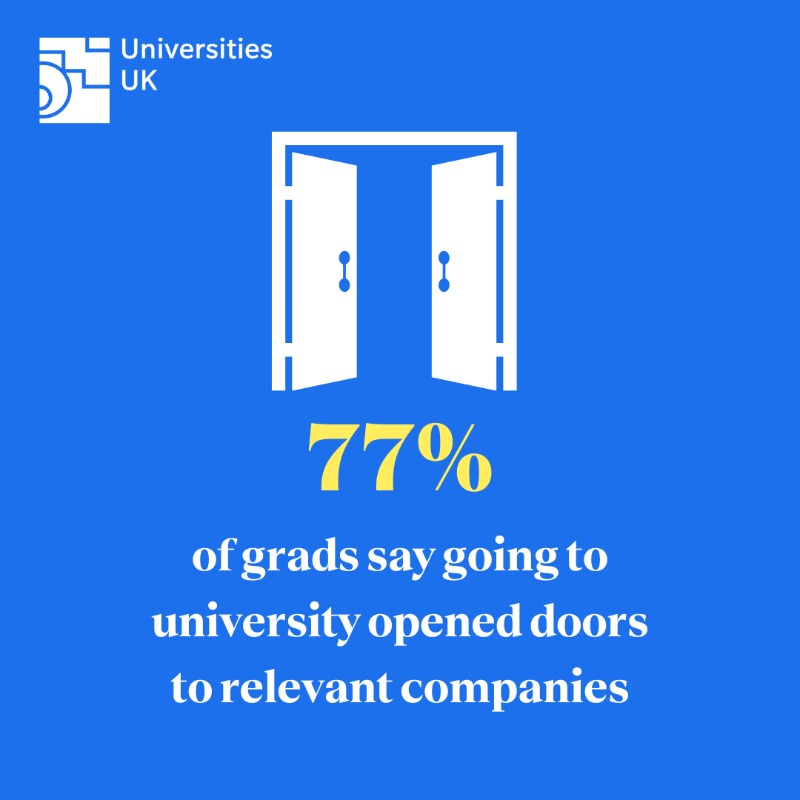
These findings are supported by the insight that 25% of graduates in the North West first gained employment through a direct connection to their university or degree course, and 84% of business leaders in the North West say that going to university opened doors into relevant companies for them. These findings highlight the strength of existing ties between universities and the private sector, and their central role in addressing skills gaps for UK industry.
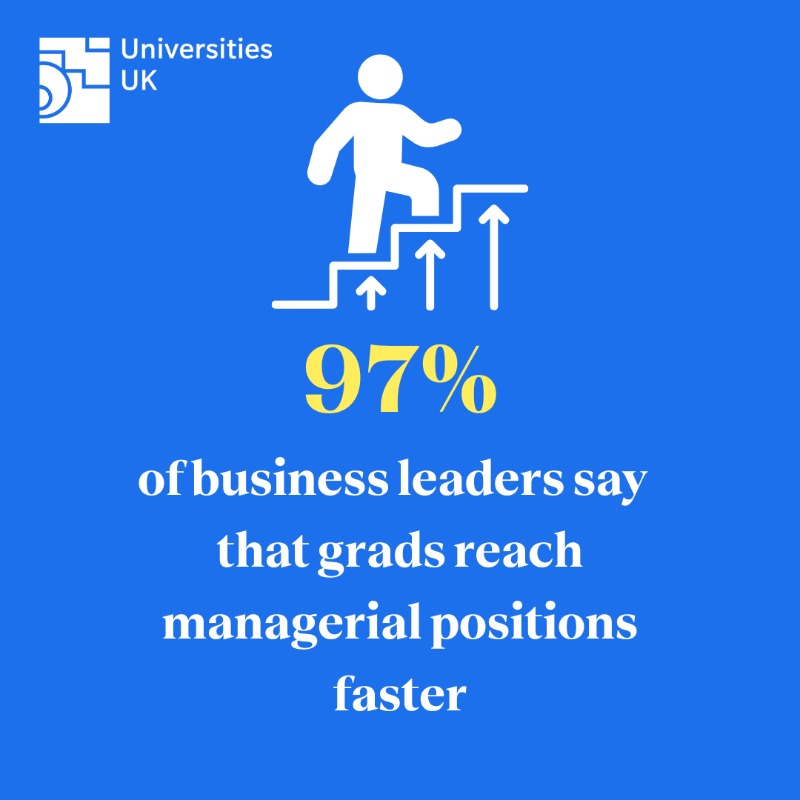
The research from UUK also outlines the broader impacts of going to university on gaining employment in the North West of England. 71% of graduates in the North West say they found their job/ role in under a year. Furthermore, 99% of business leaders in the North West say university graduates reach managerial positions faster, as a direct result of going to university.
Supporting career development:
According to the research, 58% of business leaders in the North West think graduates typically progress faster through the ranks of their business; a finding that could be linked to the insight that 72% also believe that going to university gives graduates good sector and industry knowledge. What’s more, where graduates and non-graduates are able to perform the same role in their organisation, 88% of business leaders in the North West of England would expect to see graduate employees earn more than non-graduates after 3 years.
Mature students can also benefit financially from gaining a degree. On average, business leaders in the North West expect previously non-graduate employees who obtain a degree relevant to their role to see an increase of 20% in earnings.
According to the research, 58% of business leaders in the North West think graduates typically progress faster through the ranks of their business; a finding that could be linked to the insight that 72% also believe that going to university gives graduates good sector and industry knowledge. What’s more, where graduates and non-graduates are able to perform the same role in their organisation, 88% of business leaders in the North West of England would expect to see graduate employees earn more than non-graduates after 3 years.
Mature students can also benefit financially from gaining a degree. On average, business leaders in the North West expect previously non-graduate employees who obtain a degree relevant to their role to see an increase of 20% in earnings.
Impact on social mobility:
Interestingly, at a national level the research also looked in particular at UK graduates and business leaders who were the first in their family to go to university. Of these, 78% of graduates and 71% of business leaders said that going to university opened doors into companies for them. Meanwhile, 73% of business leaders believe that going to university introduces graduates to peers who can help them build their careers, and 77% of graduates said a degree helped them build skills that have been professionally valuable.
Findings from our data and wider evidence show the role of universities as equalisers across the UK jobs market; enabling all graduates to unlock career opportunities – not just those with strong family connections or a history of higher education.

Vivienne Stern
“This new research clearly demonstrates the value that graduates benefit from when they go to university in the UK. The benefits captured by this research are numerous – from job security and career ambitions, to earnings and social mobility. They highlight how highly UK universities are regarded not just by those who attend them, but also by those who hire their graduates and benefit from their skills.
"It is clear that Universities play a huge role not only in preparing graduates for employment, but also in teaching them crucial, transferable life skills that will serve them throughout their career. Ultimately, what this research demonstrates is that our universities play a powerful role in helping graduates forge successful career paths that can help return the UK economy to growth and continue to power our public services”.