



search
date/time

Sat, 1:00PM
overcast clouds
11.6°C
WSW 9mph
overcast clouds
11.6°C
WSW 9mph
 | Sunrise | 4:06AM |
| Sunset | 8:08PM |  |

Artis-Ann
Features Writer
P.ublished 31st January 2026
arts
A Private Investigation: The Devil’s Draper By Donna Moore
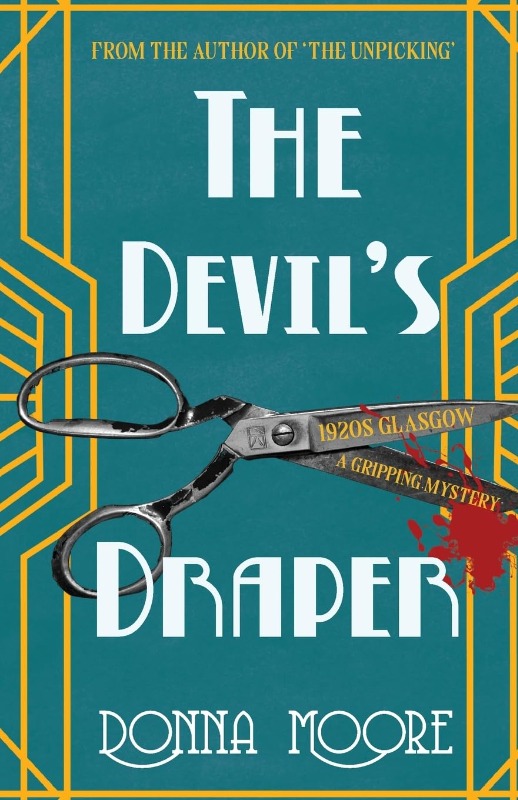
At the opening of The Devil’s Draper, Mabel has been given some field work in the Ladies Waiting Room of Glasgow Railway Station. There has been a spate of thefts and she is there to protect women from would-be thieves. There appears to be a new gang at work who need to be stopped. Needless to say, she is unsuccessful, having just ‘taken a turn’ around the station to ease her ‘aching body’ when a lady is robbed of her luggage and her jewels. Superintendent Orr, who already has a very poor opinion of Mabel, is not impressed!
The chapters then alternate between three principal characters: Mabel, Beatrice, who runs an employment agency for women, and Johnnie, who is female but prefers to dress as a man, believing it makes her more obscure; as a member of a gang of female villains, she is rather adept at theft. The simple headings are helpful, making clear the character in focus and the passage of time.
There is more than one villain and the identity of one is revealed quite without warning.
Johnnie, meanwhile, is our third protagonist and a senior member of the St Thenue’s Avengers, the gang of female thieves making away with good pickings. She discovers one of their number, Ruby, has been murdered and when no one else is prepared to do anything, she wants to avenge the death: Ruby deserves a voice. When Evvy is also found dead, Johnnie is more determined than ever, even if it means working with the Police. In 1920’s Glasgow, where women are not held in high regard, the plot thickens as three paths collide and the women collude.
This is the UK post World War One, where there are too many young women whose place in society is not as easily defined as it had been twenty years earlier, and not enough young men to keep them in check. As in The Unpicking, Moore develops our awareness of the role of women in the early part of the twentieth century. Life for them was hard; even the law favoured men, given that it was a male-dominated justice system, determined to maintain the status quo. Modern women and suffragettes, however, do not readily accept the old order and do not readily acquiesce to the expectations of men especially when they know they are unfair. Our three heroines, while making a highly unlikely trio, are determined to do right by the women they know have been wronged by men and are determined to look after each other.
The characters are well defined although with a delicate hand. Each of our three main heroines has their own sense of integrity and others such as Floss, Jo and Grandmother are well suited to time and place. Winnie, who oversees the ladies’ public toilets, makes the role her own. Hector Arrol is as charming and sycophantic as he needs to be, when he needs to be, but is far from the pleasant chap he tries to appear: another man determined to abuse his power. His offspring reveal their various character traits with each appearance. Gilbert is a genuinely affable chap even if he cannot see what is right in front of him, while Arthur and Roderick are somewhat less appealing and their sister Eliza, understandably outranked by them all, has only a minor role to play. Superintendent Orr is the misogynist whose disdainful attitude to Mabel is shocking to the modern reader while Detective Inspector Lorrimer is somewhat more human and sympathetic to the cause. Meg, who leads the St Thenue’s Avengers, is cold-hearted and efficient. She becomes less likeable as the narrative proceeds and proceed it does, at a pace.
Our three heroines, while making a highly unlikely trio, are determined to do right by the women they know have been wronged by men and are determined to look after each other.
Moore’s descriptions of the period are detailed: the Dadaist Art movement, the suppers, the dancing, the fashions, the wares on display in the grand shops contrast with the dark underbelly of Glasgow and its criminal world, all adding to the atmosphere and creating an authentic sense of time and place.
At the end, Beatrice suggests opening a detective agency, yielding, perhaps, another opportunity for Moore to make this a trilogy.
More information here.
Also by Artis-Ann ...
'Yes, M’lady': A Thorn in the Rose By Samantha Lee HoweThe Danger Of Secrets: A Dark Death By Alice FitzpatrickDeath Is Not Always The End: Accidents Will Happen By Andrew J. FieldA Dish Best Served Cold: An Eye For An Eye By Jeffrey ArcherChoices Are Never Easy: Birnam Wood By Eleanor Catton