



search
date/time

Wed, 10:00PM
light rain
15.9°C
S 12mph
light rain
15.9°C
S 12mph
 | Sunrise | 3:42AM |
| Sunset | 8:47PM |  |
P.ublished 1st July 2026
business
IoD: Confidence Declines As Operating Conditions Worsen
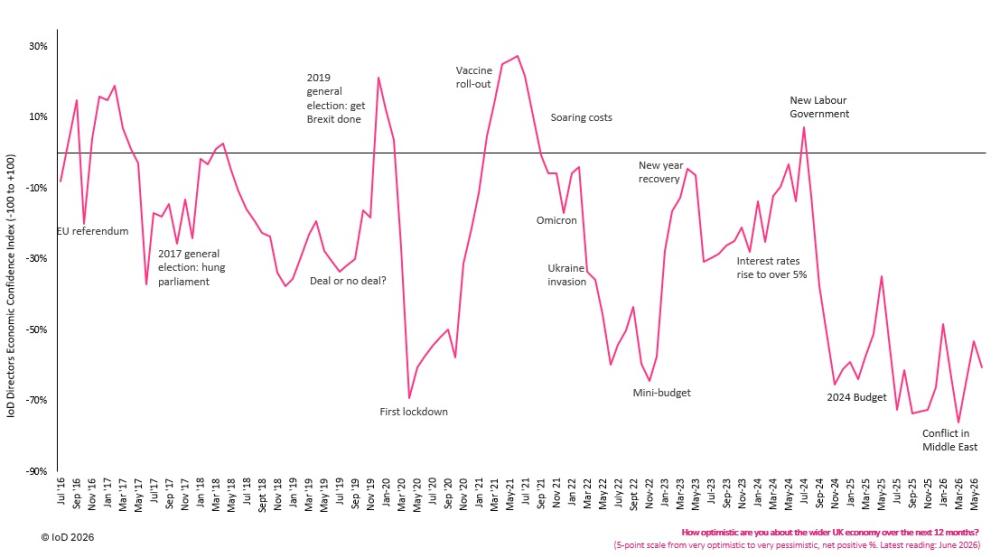
This was matched by a marked fall in confidence in respondents’ own organisations, down to +7 from +23 in May.
Most underlying indicators pointed to softening expectations:
Revenue expectations fell sharply to +11 (from +27) — the weakest reading so far in 2026
Investment intentions edged down to -4 (from -1)
Export expectations dipped to +7 (from +9)
Headcount expectations remained unchanged at -3
Cost expectations remained elevated at +83 (from +84)
Supply chain concerns persisted, with 43% of business leaders saying that they were concerned about shortages affecting their operations due to the conflict in the Middle East, albeit down from 52% in April.
Among those reporting concern, the most frequently cited shortages were:
Fuel or energy: 73% (down from 76% in April)
Industrial materials: 39% (up from 34%)
Components or parts: 26% (down from 35%)
Food or agricultural inputs (including fertilisers and animal feed): 24% (up from 16%)
Medicines or medical supplies: 21% (up from 10%)
Despite these concerns, business responses remain limited. A quarter (25%) of business leaders report increased awareness of supply chains (unchanged since April), while a significant 41% say they plan to take no action (from 37%) to mitigate potential shortages.
Cost pressures remain a key challenge for firms. 72% of businesses reported higher energy and fuel costs over the past three months compared to the previous quarter, with 21% reporting a significant increase. Looking ahead, 63% expect energy and fuel costs to rise further over the next three months, with 13% anticipating significant increases.
Despite a fragile peace in the Middle East, overall operating conditions worsened for businesses in June. Revenue expectations dropped back markedly and, with cost expectations stable at an elevated level, the squeeze on margins increased. Overall, 72% of businesses have seen their energy and fuel costs increase over the past three months, with a fifth reporting rises of at least 25%.
Four fifths of businesses now report that business disruption and economic uncertainty are becoming normalised. As well as easing back on investment and hiring, this is pushing businesses to prioritise resilience over expansion, maintain higher reserves, reduce discretionary spend, diversify their supply chains and enhance their risk management. As we face into yet another refresh of the government’s priorities for growth, the need to create a supportive environment is becoming more acute. While there is a logic to changes in the machinery of government, what matters is delivery on the ground. Businesses need to see meaningful improvements in areas like regulatory cost, tax complexity and swiftness and consistency of government decisions to fundamentally unlock spending and get growth going.
The IoD Directors’ Economic Confidence Index measures the net % positive answers from members of the Institute of Directors to the question ‘How optimistic are you about the wider UK economy over the next 12 months?’ on a five-point scale from ‘very optimistic’ to ‘very pessimistic’.
| Very optimistic | Quite optimistic | Neither optimistic nor pessimistic | Quite pessimistic | Very pessimistic | Don't know | |
| Wider UK economy | 0.4% | 8.4% | 21.6% | 44.3% | 25.1% | 0.2% |
| Your (primary) organisation | 4.4% | 28.9% | 39.9% | 21.4% | 5.1% | 0.4% |
Full Results
454 responses from across the UK, conducted between 12-29 June 2026.13% ran large businesses (250+ people), 20% medium (50-249), 20% small (10-49 people), 35% micro (2-9 people) and 11% sole trader and self-employed business entities (0-1 people).